
Author: ABeWER Clinical Team
Introduction: Why Nurses Are Central to Pressure Ulcer Prevention
Nurses are the primary drivers of pressure ulcer prevention and wound healing in every hospital environment. Their continuous presence at the bedside places nurses in a unique position to detect early signs of pressure injury and intervene before bed sores develop into complex clinical conditions.
The growing burden of pressure ulcer cases in the hospital setting has elevated the importance of structured prevention strategies. Nurses are not only responsible for implementing these strategies but also for adapting them to individual patient needs. Effective wound healing begins with prevention, and prevention begins with nurses.
As clinical expectations evolve, hospitals increasingly rely on advanced support surfaces such as the multifunction lateral turning mattress to enhance care consistency. These technologies extend nurses’ clinical capability rather than replacing it.
Clinical Understanding of Pressure Ulcers and Pressure Injury Development
A pressure ulcer forms when sustained pressure compromises blood flow, leading to tissue ischemia. This process, if not interrupted, progresses into a pressure injury with varying degrees of severity. Bed sores remain a common manifestation of prolonged immobility in hospital patients.
Although the term decubitus ulcers appears less frequently in modern clinical language, it still reflects the same underlying pathology. Nurses must be proficient in recognizing early tissue changes to prevent escalation.
The pathophysiology of pressure ulcer development is multifactorial. Shear forces, friction, moisture, and impaired mobility all contribute to tissue breakdown. These factors also delay wound healing, making early intervention critical.
The Expanding Role of Nurses in Evidence-Based Prevention
Nurses are responsible for translating clinical guidelines into daily practice. This includes structured risk assessments, repositioning protocols, and the selection of appropriate support surfaces.
International recommendations emphasize that repositioning is essential for preventing pressure injury, regardless of the support surface used. However, maintaining strict repositioning schedules in a busy hospital environment is challenging.
To support wound healing and prevent bed sores, nurses must combine clinical judgment with technology. The use of an alternating pressure air mattress allows for dynamic pressure redistribution, reducing tissue stress over time.
Repositioning Limitations and the Need for Innovation
Manual repositioning remains a standard practice, yet it is often inconsistent due to workload pressures. Nurses working in high-demand hospital settings may struggle to maintain optimal repositioning intervals, increasing the risk of pressure ulcer formation.
In addition, manual handling introduces physical strain, which can impact both nurses and patient safety. These limitations highlight the need for automated solutions such as a lateral turning mattress.
A lateral turning mattress supports continuous repositioning, ensuring that patients receive consistent pressure relief even when staffing resources are limited. This innovation directly supports nurses in maintaining adherence to clinical guidelines.
Support Surface Technology: From Basic to Multifunction Systems
Support surfaces have evolved significantly, moving from static designs to advanced multifunction systems. The alternating pressure air mattress remains a widely used solution, offering cyclic pressure redistribution that supports tissue perfusion.
However, newer technologies such as the multifunction lateral turning mattress provide additional benefits. These include automated repositioning, microclimate management, and shear reduction. Each of these features contributes to improved wound healing outcomes.
A multifunction system allows nurses to deliver more precise and individualized care. By integrating multiple therapeutic functions into a single platform, these systems reduce the complexity of care delivery in the hospital setting.
ABeWER Solutions: Bridging Clinical Practice and Technology
ABeWER’s approach is grounded in clinical evidence and designed to support nurses in real-world hospital conditions.
The multifunction lateral turning mattress (MLTM) system provides automated lateral positioning aligned with clinical recommendations. This reduces reliance on manual repositioning while ensuring consistent pressure redistribution.
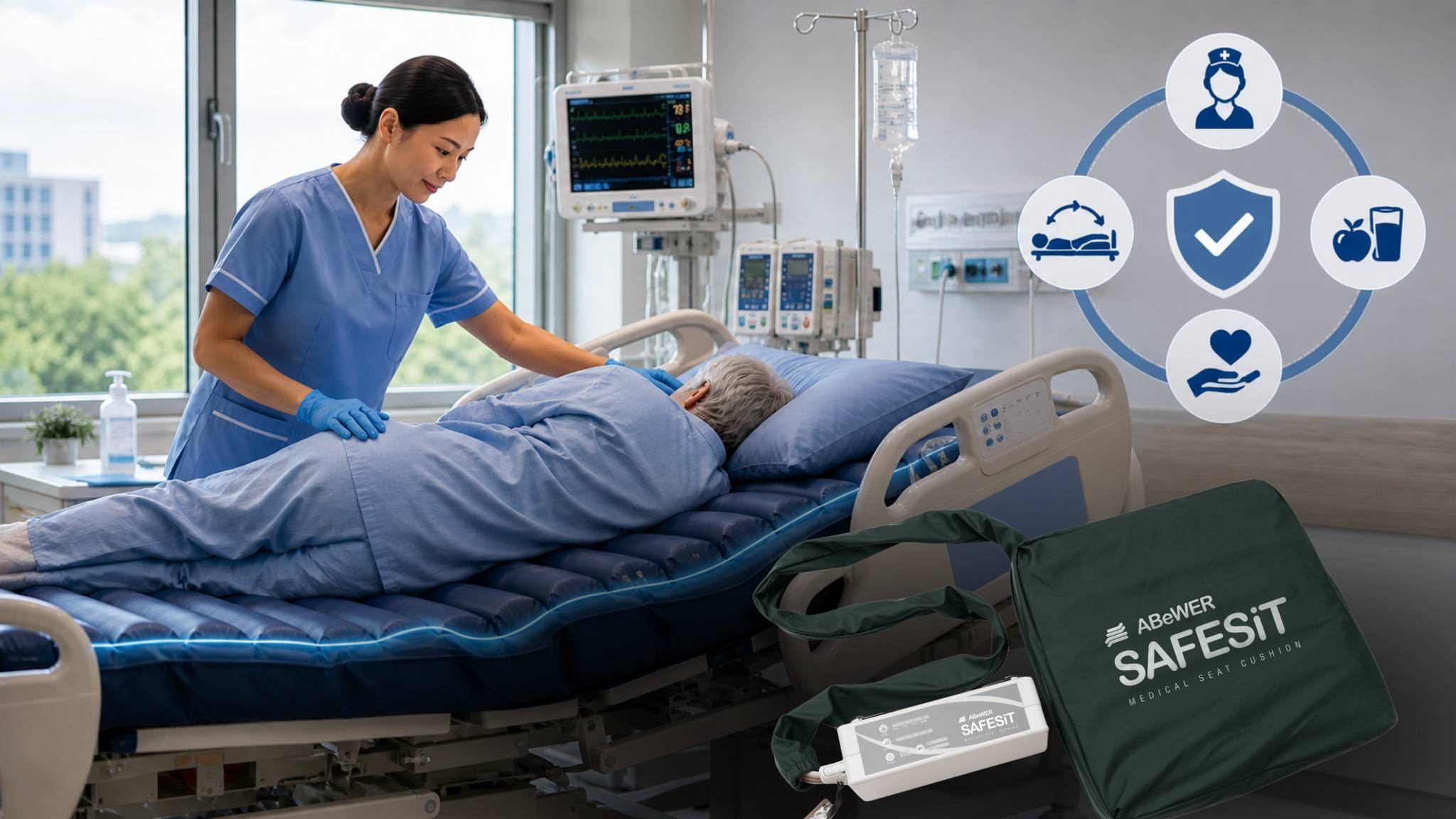
The multiTURN® 6 system enhances patient handling by enabling controlled, programmable movement. This supports nurses in maintaining optimal positioning without increasing workload. The multiTURN® 6 EBT system builds on this functionality, offering greater adaptability for complex patient needs when transfers with the bed are required.
In seated care, the SAFESiT® Multicycle alternating pressure air cushion addresses localized pressure risks. This ensures continuity of care beyond the bed and supports ongoing wound healing.
These solutions form part of an integrated care strategy, helping nurses deliver safer, more effective interventions.
Enhancing Wound Healing Through Technology Integration
Wound healing is directly influenced by pressure management. Continuous pressure disrupts circulation, delaying tissue repair. By contrast, effective pressure redistribution promotes oxygenation and nutrient delivery.
The use of an alternating pressure air mattress combined with a lateral turning mattress creates a synergistic effect. Together, they reduce prolonged pressure exposure and support natural wound healing processes.
Multifunction systems further enhance this effect by controlling environmental factors such as temperature and moisture. This creates optimal conditions for wound healing while reducing the risk of bed sores.
Nurses, Education, and Certification in Modern Care
The integration of advanced technologies into clinical practice requires ongoing education. Nurses must understand not only how to use these systems but also when and why to apply them.
Training programs increasingly include the use of a lateral turning mattress and alternating pressure air mattress as core competencies. This reflects the growing importance of technology in pressure ulcer prevention.
ABeWER supports this transition by aligning its solutions with clinical training standards. Systems such as multiTURN® 6 and multiTURN® 6 EBT enable nurses to apply theoretical knowledge in practical settings, strengthening both competence and confidence.
Image 1. Nurses use ABeWER’s SAFESiT® alongside multiTURN® 6 to deliver continuous pressure injury prevention across bed and seated care.
Hospital Outcomes and Operational Efficiency
Preventing pressure ulcer and pressure injury is a priority for every hospital. These conditions are associated with increased morbidity, longer stays, and higher treatment costs.
By adopting multifunction support surfaces, hospitals can reduce the incidence of bed sores and improve patient outcomes. At the same time, these systems reduce the physical demands placed on nurses, contributing to better staff retention and satisfaction.
The integration of the multifunction lateral turning mattress and SAFESiT® Multicycle alternating pressure air cushion supports a comprehensive prevention strategy that benefits both patients and healthcare providers.
Conclusion: Elevating Nursing Practice Through Innovation
Nurses remain the foundation of pressure ulcer prevention and wound healing in the hospital environment. Their expertise, combined with evidence-based protocols, ensures high standards of patient care.
However, modern challenges require modern solutions. Technologies such as the multifunction lateral turning mattress (MLTM) system, alternating pressure air mattress, multiTURN® 6, and multiTURN® 6 EBT systems provide essential support for nurses.
ABeWER’s role is to enable clinical excellence, not replace it. By integrating advanced support surfaces into daily practice, hospitals can strengthen prevention strategies, improve wound healing outcomes, and reinforce the critical role of nurses in patient care.
References
ABeWER (2026) MLTM vs standard mattresses for stage 4 pressure injuries. Available at: https://abewer.com/mltm-vs-standard-mattresses-for-stage-4-pressure-injuries/.
National Pressure Injury Advisory Panel, European Pressure Ulcer Advisory Panel and Pan Pacific Pressure Injury Alliance (2025) Prevention and Treatment of Pressure Ulcers/Injuries: Quick Reference Guide. Available at: https://internationalguideline.com.
University of Sheffield (2023) Harvard Referencing Guide. Available at: https://www.sheffield.ac.uk/library.